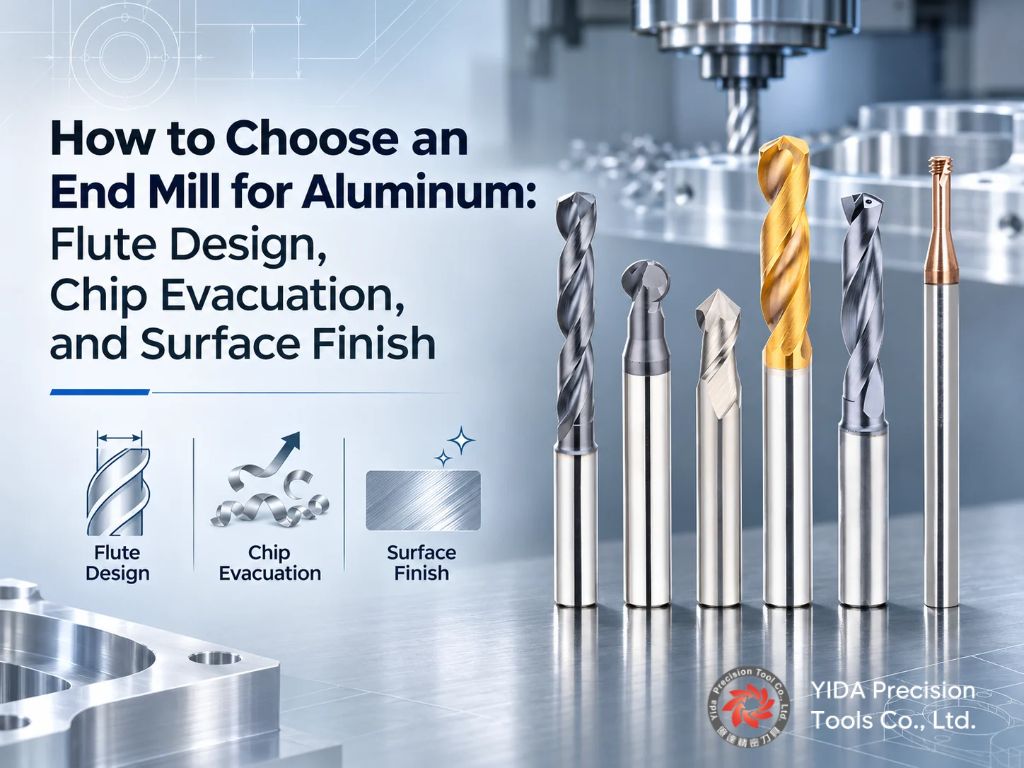
Aluminum is widely used in automotive parts, aerospace components, electronics, molds, fixtures, and general precision machining because of its low weight, good machinability, and versatility.
However, machining aluminum efficiently requires more than simply using any carbide end mill.
Because aluminum is relatively soft and ductile, chips can build up quickly around the cutting edge. If the end mill does not provide enough chip space or the cutting edge is not sharp enough, problems such as built-up edge, poor surface finish, excessive heat, and unstable cutting may occur.
For this reason, choosing the right end mill for aluminum requires careful consideration of flute count, flute geometry, chip evacuation, tool length, cutting conditions, and the required surface finish.
YIDA Precision Tools’ Hummingbird YDS33 series is designed for soft-metal machining, including aluminum, copper, brass, and other non-ferrous materials. This guide explains the key factors to consider when selecting a carbide end mill for aluminum machining.
- Why Does Aluminum Need a Different End Mill?
- Flute Count: 2-Flute, 3-Flute, or 4-Flute?
- Why Chip Evacuation Is Critical in Aluminum Machining
- Sharp Cutting Edges Help Reduce Cutting Resistance
- How Flute Geometry Affects Chip Flow
- How to Improve Surface Finish When Milling Aluminum
- Slotting vs. Side Milling: Does the End Mill Selection Change?
- Ball Nose and Corner Radius End Mills for Aluminum
- What About Long Shank and Long Flute End Mills?
- A Practical Selection Guide for Aluminum End Mills
- YIDA Hummingbird YDS33 End Mills for Aluminum
- Common Mistakes When Choosing an End Mill for Aluminum
- Choose the End Mill According to the Cutting Condition
- Frequently Asked Questions
Why Does Aluminum Need a Different End Mill?
At first glance, aluminum may seem easier to machine than hardened steel because of its lower hardness.
But aluminum creates a different set of machining challenges.
The material is relatively soft, which allows the cutting edge to remove material easily. At the same time, aluminum can be ductile and adhesive, meaning chips may stick to the cutting edge instead of leaving the cutting zone cleanly.
This can lead to:
- Built-up edge
- Chip welding
- Poor surface finish
- Burr formation
- Increased cutting forces
- Excessive heat around the tool
- Reduced tool life
- Unstable machining
An end mill designed for hardened steel may have a geometry optimized for edge strength and wear resistance, but it may not provide the large chip space or sharp cutting action required for aluminum.
This is why aluminum-specific end mills are generally designed around three priorities:
- Sharp cutting edges
- Effective chip evacuation
- Low cutting resistance
Flute Count: 2-Flute, 3-Flute, or 4-Flute?
Flute count is one of the first specifications to consider when choosing an aluminum end mill.
Each flute removes material during rotation, but each additional flute also reduces the space available for chips.
For aluminum machining, chip evacuation is especially important because the material can produce large, continuous chips.
2-Flute End Mills
A 2-flute end mill provides large flute valleys and more open space for chip evacuation.
This makes it particularly useful for:
- Slotting
- Deep pockets
- Applications with high chip volume
- Machining conditions where chip evacuation is the main concern
The larger flute space helps reduce the chance of chips accumulating inside the cutting zone.
For this reason, 2-flute end mills are commonly selected when machining aluminum with relatively high material removal rates.
3-Flute End Mills
A 3-flute end mill provides a balance between chip evacuation and the number of cutting edges.
Compared with a 2-flute tool, the additional cutting edge can support higher feed potential and may improve surface quality in suitable machining conditions.
At the same time, it still provides more chip space than many higher-flute-count tools.
A 3-flute aluminum end mill is often useful for:
- General aluminum milling
- Side milling
- Pocketing
- Finishing
- Applications requiring a balance between productivity and chip evacuation
4-Flute End Mills
A 4-flute end mill provides more cutting edges, but it also provides less space between the flutes.
This does not mean a 4-flute tool cannot be used for aluminum. However, the machining strategy and chip evacuation conditions become more important.
If chips cannot leave the cutting zone efficiently, they may become trapped between the tool and workpiece.
Therefore, a 4-flute configuration may be more appropriate in applications where:
- Radial engagement is limited
- Chip volume is lower
- Air blast or coolant assists chip evacuation
- Surface finish is a higher priority
- The tool geometry is specifically designed for aluminum machining
The most suitable flute count should therefore be selected according to both the machining operation and the available chip space.
Why Chip Evacuation Is Critical in Aluminum Machining
Chip evacuation is one of the most important factors in successful aluminum milling.
During cutting, the end mill continuously creates chips. These chips must leave the cutting zone before the next cutting edge enters the same area.
If they remain around the tool, several problems can occur.
Chip Recutting
When chips remain inside a pocket or slot, the cutter may recut them.
Instead of cutting fresh material, the cutting edge repeatedly contacts loose chips.
This can increase:
- Cutting temperature
- Surface scratches
- Tool wear
- Cutting forces
It can also reduce the consistency of the finished surface.
Chip Welding
Aluminum chips may adhere to the tool under unsuitable cutting conditions.
As aluminum accumulates on the cutting edge, the effective tool geometry changes.
The tool may no longer cut cleanly, resulting in:
- Rough surfaces
- Dimensional variation
- Increased vibration
- Higher cutting load
This condition is commonly associated with built-up edge.
Chip Packing in Deep Pockets
Deep slots and pockets make chip evacuation more difficult because the chips must travel farther before leaving the cutting area.
This is why applications involving deep cavities often benefit from:
- Fewer flutes
- Wider flute spaces
- Shorter tool engagement where possible
- Effective coolant or air blast
- Suitable toolpaths that create room for chip evacuation
The more confined the machining area, the more important chip management becomes.
Sharp Cutting Edges Help Reduce Cutting Resistance
An aluminum end mill should generally cut the material cleanly instead of pushing or rubbing against it.
A sharp cutting edge helps reduce the force required to shear the material.
This can provide several benefits:
- Lower cutting resistance
- Reduced heat generation
- Cleaner chip formation
- Improved surface quality
- Lower risk of built-up edge
Because aluminum is softer than hardened steel, the cutting edge does not need to prioritize extreme edge reinforcement in the same way.
Instead, cutting sharpness and smooth chip flow often become more important.
This is one of the key reasons aluminum-specific end mills should not simply be treated as general-purpose carbide end mills.
How Flute Geometry Affects Chip Flow
Flute count is important, but flute geometry also affects how chips leave the cutting zone.
The flute must provide enough space and a suitable path for chips to move upward and away from the workpiece.
An effective flute design can help:
- Move chips away from the cutting edge
- Reduce chip recutting
- Prevent chip packing
- Improve coolant or air access
- Maintain more stable cutting conditions
This becomes particularly important during:
- Slotting
- Deep pocket machining
- High-feed machining
- Long cutting cycles
- High material-removal applications
When comparing two aluminum end mills with the same diameter and flute count, differences in flute shape can still produce noticeably different machining results.
How to Improve Surface Finish When Milling Aluminum
A good surface finish depends on more than the number of flutes.
The final result is influenced by the entire cutting system.
1. Use the Right End Mill Geometry
Sharp cutting edges and proper flute geometry help the tool shear the material cleanly.
If the cutting edge becomes dull or begins to develop built-up edge, surface quality can deteriorate quickly.
2. Control Tool Runout
Excessive runout causes one cutting edge to remove more material than the others.
This can create uneven cutter marks and increase tool wear.
Good toolholding and accurate spindle conditions are therefore important for finishing operations.
3. Avoid Excessive Tool Overhang
Long tool overhang reduces rigidity.
The lower rigidity can increase vibration and tool deflection, which may leave inconsistent machining marks on the finished surface.
The shortest practical tool length should generally be used whenever the part geometry allows.
4. Optimize Feed and Speed
Very conservative cutting conditions do not automatically improve surface finish.
If the cutting edge rubs instead of cutting properly, heat and built-up edge may increase.
Cutting parameters should therefore be selected according to:
- Tool diameter
- Flute count
- Aluminum grade
- Radial engagement
- Axial depth of cut
- Machine rigidity
- Coolant or air supply
Manufacturer-recommended cutting parameters should be used as the initial reference and then adjusted according to actual machining conditions.
5. Keep Chips Away From the Finished Surface
Even with the correct tool, chips trapped between the cutter and the workpiece can scratch the machined surface.
Effective chip evacuation is therefore directly related to surface quality.
Slotting vs. Side Milling: Does the End Mill Selection Change?
Yes.
The amount of cutter engagement strongly affects chip evacuation.
Full Slotting
During full slotting, much of the cutter diameter is engaged in the material.
This produces a large volume of chips and leaves less room for those chips to escape.
For aluminum slotting, greater chip clearance becomes especially important.
A lower flute count and open flute geometry may therefore be advantageous.
Side Milling
During side milling, only part of the cutter diameter is engaged.
This generally creates more open space for chips to escape.
Because chip evacuation is less restricted, a higher flute count may sometimes be practical, depending on the radial engagement, feed rate, and surface finish requirements.
This is why the same aluminum component may require different end mill configurations for roughing, slotting, and finishing.
Ball Nose and Corner Radius End Mills for Aluminum
Aluminum machining is not limited to square end mills.
Different component geometries may require other cutting-end designs.
Ball Nose End Mills
A ball nose end mill is suitable for:
- 3D contouring
- Curved surfaces
- Mold machining
- Freeform profiles
- Rounded cavities
When machining aluminum molds or complex 3D components, the combination of suitable aluminum cutting geometry and ball nose design can support smoother curved-surface machining.
Corner Radius End Mills
A corner radius end mill is useful when:
- Flat-bottom machining is required
- The component allows an internal radius
- Stronger cutting corners are desirable
- Side milling or profiling is involved
The radius helps reinforce the cutting corner while still allowing the tool to create relatively flat bottom surfaces.
The choice between square, ball nose, and corner radius geometry should therefore be based on the required part geometry first, followed by flute count and chip evacuation requirements.
What About Long Shank and Long Flute End Mills?
Some components contain deep walls, recessed surfaces, or hard-to-reach areas.
In these situations, a long shank or long flute end mill may be necessary.
However, longer tools introduce additional considerations.
As tool length increases, rigidity decreases.
This can lead to:
- Chatter
- Tool deflection
- Reduced dimensional accuracy
- Poorer surface finish
- Increased risk of tool breakage
A longer end mill should therefore be selected only when the component geometry requires additional reach.
Whenever possible, use the shortest practical tool configuration that can access the machining feature.
A Practical Selection Guide for Aluminum End Mills
The following table provides a simple starting point.
| Machining Situation | Primary Concern | End Mill Selection Direction |
|---|---|---|
| Deep slotting | Chip evacuation | Lower flute count and larger chip space |
| General aluminum milling | Balance of productivity and chip removal | 2- or 3-flute aluminum end mill |
| Side milling | Stability and finish | Select flute count according to radial engagement |
| Fine finishing | Surface quality | Sharp cutting edge, controlled runout, stable setup |
| Deep pocket | Chip packing | Open flute design and effective chip removal |
| 3D contouring | Surface geometry | Aluminum ball nose end mill |
| Flat-bottom profiling with radius allowed | Edge strength | Aluminum corner radius end mill |
This table should be used as a starting point rather than a fixed rule.
Actual tool selection still depends on machine capability, workpiece geometry, cutting parameters, material grade, tool diameter, and production requirements.
YIDA Hummingbird YDS33 End Mills for Aluminum
YIDA Precision Tools developed the Hummingbird YDS33 series for soft-metal machining.
The series is designed around aluminum machining and can also be used for other soft non-ferrous materials such as copper and brass.
This makes the series suitable for manufacturers that require carbide end mills specifically selected for soft-metal machining rather than relying on a general-purpose cutter.
You can explore YIDA’s aluminum machining series here:
When choosing an end mill from the YDS33 series, manufacturers should consider:
- Workpiece material
- Required cutting-end geometry
- Tool diameter
- Flute count
- Cutting depth
- Tool reach
- Chip evacuation conditions
- Required surface finish
The goal is not simply to use an “aluminum end mill,” but to select the aluminum end mill configuration that best matches the actual machining operation.
Common Mistakes When Choosing an End Mill for Aluminum
Using an End Mill Designed Primarily for Hard Steel
Hard-steel tooling may prioritize cutting-edge strength and wear resistance rather than open chip space and sharp aluminum cutting geometry.
This can reduce chip evacuation efficiency in aluminum applications.
Choosing Too Many Flutes for a High-Chip-Volume Operation
More cutting edges do not automatically mean better performance.
If the flute valleys cannot carry chips away quickly enough, chip packing and recutting may reduce machining stability.
Ignoring Chip Evacuation in Deep Pockets
A tool may perform well during open side milling but experience problems inside a deep pocket because the chips have fewer escape paths.
Using an Excessively Long Tool
Extra tool length should only be used when required by the component.
Unnecessary overhang can reduce rigidity and surface quality.
Focusing Only on Surface Finish
A high-quality finish depends on proper chip evacuation, machine stability, tool sharpness, toolholding, and cutting parameters.
Changing to a higher flute count alone will not solve every surface-finish problem.
Choose the End Mill According to the Cutting Condition
The best end mill for aluminum is not determined by one specification.
A successful selection considers the complete machining condition.
For high-chip-volume operations such as slotting, chip space and evacuation may be the highest priority.
For side milling and finishing, cutting stability, tool runout, cutting-edge sharpness, and surface requirements become more important.
For deep pockets, tool reach must be balanced against rigidity.
And for complex geometries, square, ball nose, or corner radius designs should be selected according to the required workpiece shape.
As a carbide cutting tool manufacturer, YIDA Precision Tools provides the Hummingbird YDS33 series for aluminum and other soft non-ferrous metal machining. By matching flute design, cutting geometry, chip evacuation, and tool length to the actual machining condition, manufacturers can achieve more stable cutting, cleaner surfaces, and more efficient aluminum machining.
Need Help Selecting an End Mill for Aluminum?
Contact YIDA Precision Tools with your workpiece material, part geometry, required tool dimensions, and machining conditions. Our team can help you identify a suitable carbide end mill for your aluminum machining application.
Frequently Asked Questions
How Many Flutes Should an End Mill for Aluminum Have?
There is no single flute count that is best for every aluminum machining operation. Two-flute tools provide more chip space and are useful for high-chip-volume operations such as slotting. Three-flute tools can provide a balance between chip evacuation, feed capability, and surface quality. Higher flute counts may be suitable when chip volume is lower and evacuation conditions are well controlled.
Why Do Aluminum Chips Stick to an End Mill?
Aluminum is relatively ductile and may adhere to the cutting edge when heat, friction, chip evacuation, or cutting conditions are unfavorable. This can create built-up edge, which changes the effective cutting geometry and may lead to rough surfaces, higher cutting forces, and unstable machining. Using a sharp aluminum-specific end mill together with effective chip evacuation can help reduce this problem.
What Causes Poor Surface Finish When Milling Aluminum?
Common causes include built-up edge, dull cutting edges, chip recutting, excessive tool runout, vibration, excessive tool overhang, poor chip evacuation, and unsuitable cutting parameters. Improving surface finish therefore requires more than simply increasing flute count; tool geometry, machine rigidity, chip control, toolholding, and cutting conditions should all be evaluated together.