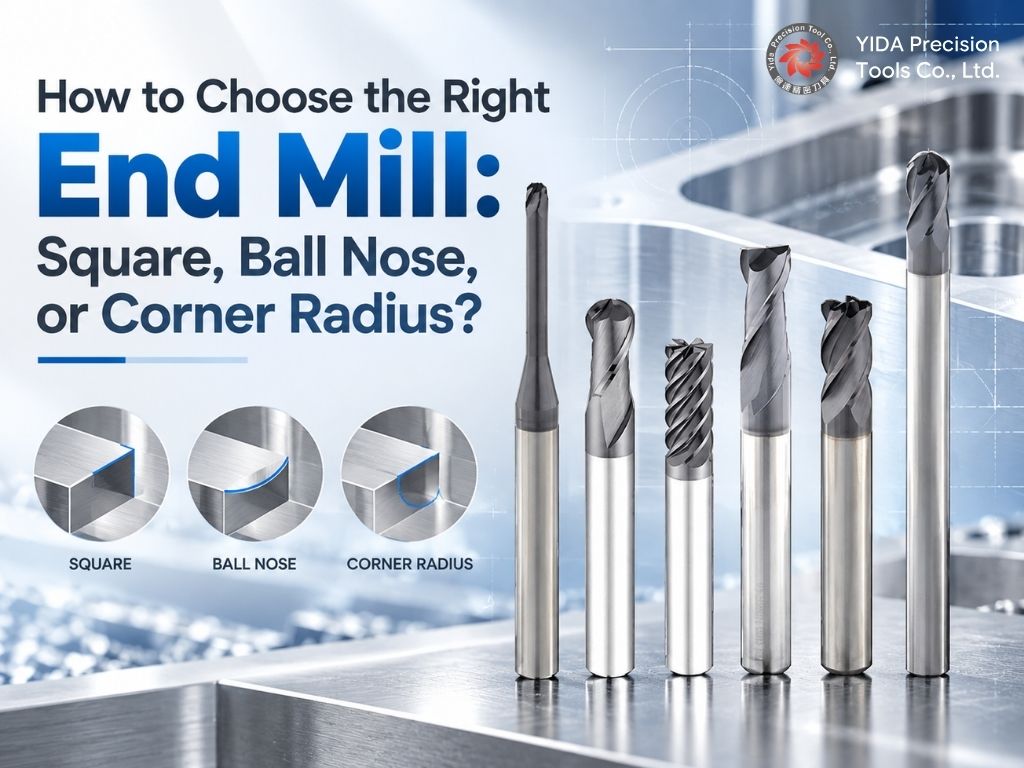
Selecting the right end mill is not simply a matter of choosing the correct diameter. The geometry at the cutting end has a direct influence on how the tool engages the workpiece, the type of feature it can produce, cutting stability, surface finish, and tool life.
Among the most commonly used milling tools, square end mills, ball nose end mills, and corner radius end mills each serve a different machining purpose. A square end mill is often selected when flat bottoms and defined corners are required. A ball nose end mill is better suited to curved surfaces and three-dimensional contours, while a corner radius end mill provides a balance between dimensional accuracy and cutting-edge strength.
Understanding these differences helps manufacturers select a carbide tool based on the actual machining operation rather than relying on one end mill for every application.
At YIDA Precision Tools, we manufacture carbide end mills for different materials, hardness ranges, geometries, and machining requirements. This guide explains how square, ball nose, and corner radius end mills differ and what factors should be considered before selecting a milling tool.
- What Is an End Mill?
- Square vs. Ball Nose vs. Corner Radius End Mills
- 1. When Should You Use a Square End Mill?
- 2. When Should You Use a Ball Nose End Mill?
- 3. When Should You Use a Corner Radius End Mill?
- How Do You Choose Between the Three?
- Workpiece Material Matters as Much as Tool Shape
- Do Not Ignore Flute Count
- Match the End Mill to the Material Hardness
- A Practical End Mill Selection Process
- Common End Mill Selection Mistakes
- Choosing the Right Carbide End Mill
- Frequently Asked Questions
What Is an End Mill?
An end mill is a rotary cutting tool used in milling machines and CNC machining centers to remove material from a workpiece. Unlike a conventional drill that is primarily designed to cut axially into a material, an end mill can perform cutting operations with both its end cutting edges and peripheral flutes, depending on its geometry and application.
End mills are commonly used for operations such as:
- Side milling
- Slot milling
- Pocket machining
- Contouring
- Profile milling
- Surface finishing
- Die and mold machining
- Roughing and finishing
However, not every end mill is suitable for all of these operations. The shape of the cutting end is one of the first factors that should be considered when choosing a milling tool. Square, ball nose, and corner radius geometries produce different tool-workpiece contact conditions and therefore behave differently during machining.
Square vs. Ball Nose vs. Corner Radius End Mills
The basic differences can be summarized as follows:
| End Mill Type | Cutting-End Geometry | Typical Applications | Main Advantage |
|---|---|---|---|
| Square End Mill | Flat cutting end with relatively sharp corners | Slotting, side milling, pockets, shoulders, flat-bottom features | Produces flat surfaces and defined corners |
| Ball Nose End Mill | Fully rounded cutting end | 3D contouring, curved surfaces, die and mold machining | Follows complex curved geometry smoothly |
| Corner Radius End Mill | Flat end with a radius at the outside corners | Profiling, pocketing, harder materials, semi-finishing and finishing | Combines flat-bottom machining with stronger cutting corners |
The best choice depends on the geometry of the part and the machining objective.
1. When Should You Use a Square End Mill?
A square end mill has a flat cutting end and relatively sharp outside corners. It is one of the most versatile end mill designs and is widely used in general CNC milling.
Square end mills are particularly useful when the finished component requires:
- Flat-bottom slots
- Flat pocket floors
- Straight side walls
- Defined shoulders
- Sharp transitions between horizontal and vertical surfaces
For example, when machining a rectangular pocket with a flat bottom, a square end mill allows the cutting edge to generate the required bottom geometry efficiently.
Advantages of Square End Mills
One of the main advantages of a square end mill is dimensional control. Because the tool has a flat end, it can produce a flat machined surface without leaving the curved profile associated with a ball nose tool.
Square end mills are also available in different flute counts, lengths, cutting diameters, and geometries, making them suitable for a wide variety of machining conditions.
What Should You Consider?
The outside corner of a square end mill experiences concentrated cutting forces. Under demanding conditions, particularly when machining harder materials or using aggressive cutting parameters, the corner can become an area of increased wear or chipping.
Tool selection should therefore consider:
- Workpiece hardness
- Depth of cut
- Radial engagement
- Machine rigidity
- Tool overhang
- Cutting speed and feed
- Required surface finish
A square end mill is an excellent general-purpose choice, but it is not automatically the best tool when cutting-edge strength is the highest priority.
2. When Should You Use a Ball Nose End Mill?
A ball nose end mill has a fully rounded cutting end. Instead of producing a flat profile across the entire tool diameter, the radius allows the tool to follow curved and three-dimensional surfaces.
For this reason, ball nose end mills are widely used in:
- Mold cavities
- Dies
- 3D contours
- Sculptured surfaces
- Rounded grooves
- Complex component profiles
- Semi-finishing and finishing operations
When a part contains continuous curves or freeform geometry, a ball nose end mill can follow the programmed toolpath while maintaining smooth contact with the workpiece.
Why Ball Nose Geometry Works for 3D Machining
The rounded end provides multiple effective contact points as the tool travels across an inclined or curved surface.
This makes a ball nose end mill especially useful for machining components where a square end mill cannot reproduce the required geometry without leaving steps or unwanted corners.
Surface quality also depends on parameters such as stepover. A smaller stepover generally reduces the scallop height between adjacent toolpaths and can improve the finished surface, although it also increases machining time.
One Important Consideration: Cutting Speed Near the Tool Center
The effective cutting speed decreases toward the center of a ball nose end mill because the cutting diameter becomes progressively smaller. At the exact center of the tool, the theoretical surface speed approaches zero.
This means that tool orientation, machining strategy, feed rate, and contact point can significantly affect performance during 3D machining. Modern CAM strategies often try to avoid continuous cutting directly at the center of the ball whenever practical.
For applications such as die and mold machining, choosing the correct ball nose end mill together with the appropriate toolpath can therefore improve both machining efficiency and surface quality.
3. When Should You Use a Corner Radius End Mill?
A corner radius end mill can be considered a middle ground between a square end mill and a ball nose end mill.
The tool maintains a relatively flat cutting end, but the outside corners are strengthened with a specified radius.
This geometry makes it useful when the machining operation requires a flat surface but does not require a perfectly sharp internal corner.
Typical applications include:
- Pocket machining
- Side milling
- Profiling
- Semi-finishing
- Finishing
- Hard-material machining
- Applications involving higher cutting loads
Why Add a Corner Radius?
The sharp corner of a conventional square end mill can experience significant stress because cutting forces are concentrated within a relatively small area.
Introducing a radius helps distribute these forces across a larger cutting-edge area.
This can provide several benefits:
- Improved cutting-edge strength
- Greater resistance to edge chipping
- Better durability under demanding cutting conditions
- More stable machining
- Potentially longer tool life
For manufacturers machining harder materials or running repeated production cycles, these characteristics can make a corner radius end mill an attractive alternative to a standard square end mill.
Remember the Part Geometry
The radius on the tool will also be transferred to the machined component.
If the drawing requires a sharp 90-degree internal corner, a corner radius end mill may not produce the required geometry. The specified tool radius must therefore be checked against the allowable corner radius on the workpiece.
How Do You Choose Between the Three?
Instead of asking which end mill type is “best,” it is more useful to ask what the finished feature needs to look like and how the material must be removed.
| Choose This Tool | When You Need |
|---|---|
| Square End Mill | Flat bottoms, defined shoulders, slotting, side milling, and dimensional definition |
| Ball Nose End Mill | Curved surfaces, freeform geometry, 3D contouring, molds, and dies |
| Corner Radius End Mill | Flat-bottom capability with improved edge strength and a permitted corner radius |
Choose a Square End Mill When:
- The part requires a flat bottom.
- Sharp internal transitions are important.
- You are performing general slotting or side milling.
- The machining load is within the capability of the cutting edge.
- Dimensional definition is more important than maximizing corner strength.
Choose a Ball Nose End Mill When:
- The part contains curved or freeform surfaces.
- You are machining molds or dies.
- The tool must follow complex 3D contours.
- Smooth transitions across curved geometry are required.
- The operation is primarily contouring or surface finishing.
Choose a Corner Radius End Mill When:
- You need flat-bottom machining capability.
- A small radius is acceptable on the component.
- Cutting-edge durability is important.
- The workpiece is relatively hard.
- The operation involves higher mechanical loads.
- You want greater edge strength than a conventional square end mill can provide.
Workpiece Material Matters as Much as Tool Shape
Cutting geometry is only one part of end mill selection.
Two end mills with the same external shape may perform very differently if their carbide substrate, coating, flute geometry, or cutting-edge design is intended for different materials.
For example, machining aluminum requires different priorities from machining hardened steel.
Aluminum and other soft non-ferrous metals generally benefit from sharp cutting edges and effective chip evacuation. Harder steels, on the other hand, require greater cutting-edge strength, wear resistance, rigidity, and suitable tool coatings.
This is why selecting an end mill solely by diameter and shape can lead to poor machining performance.
At YIDA, our carbide end mill ranges are organized around different machining requirements, including materials below HRC 45, materials between HRC 45 and 55, high-hardness applications in the HRC 55–65 range, and soft non-ferrous metal machining.
You can explore YIDA’s main carbide end mill series here:
Matching the milling tool to both the required geometry and the workpiece material provides a more reliable foundation for machining performance.
Do Not Ignore Flute Count
Once the basic end mill shape has been selected, flute count becomes another important consideration.
The number of flutes affects both chip space and the number of cutting edges engaged during rotation.
In general, fewer flutes provide more space between cutting edges for chip evacuation, while a higher flute count can provide more cutting edges and support productive machining when chip evacuation and application conditions allow.
However, there is no universal rule stating that more flutes are always better.
The appropriate flute count depends on factors including:
- Workpiece material
- Tool diameter
- Cutting depth
- Radial engagement
- Machine spindle capability
- Feed rate
- Chip evacuation
- Surface finish requirements
Tool geometry should therefore be considered as a complete system rather than evaluating individual specifications in isolation.
Match the End Mill to the Material Hardness
Workpiece hardness has a major influence on carbide tool selection.
As hardness increases, the cutting edge is exposed to greater mechanical and thermal demands. The carbide substrate, coating, cutting geometry, and machining parameters must therefore work together.
| YIDA Series | Recommended Material Range / Direction | Typical Selection Focus |
|---|---|---|
| Lion King YDS10 | Materials below HRC 45 | General-purpose machining |
| Eagle Eye YDH88 | HRC 45–55 | Medium-to-harder material machining and high-speed cutting applications |
| Leopard YDH99 | HRC 55–65 | High-hardness material machining |
| Hummingbird YDS33 | Aluminum and other soft non-ferrous metals | Soft-metal machining and chip evacuation |
YIDA’s Leopard YDH99 series, for example, is designed for high-hardness workpieces in the HRC 55–65 range and includes square end mills, ball nose end mills, corner radius end mills, heavy cutting end mills, unequal helix end mills, and roughing end mills.
For an example of YIDA’s HRC 55–65 square end mill range, see:
This illustrates an important point: the choice between square, ball nose, and corner radius should not be separated from material selection.
A Practical End Mill Selection Process
When evaluating an end mill for a new component, the following sequence can simplify the selection process.
Step 1: Identify the Workpiece Material
Determine whether you are machining aluminum, carbon steel, alloy steel, stainless steel, hardened steel, or another material.
Step 2: Determine the Material Hardness
Hardness helps narrow down the required carbide grade, coating, and cutting-edge characteristics.
Step 3: Identify the Feature to Be Machined
Ask whether the operation involves:
- A flat pocket
- A slot
- A straight wall
- A curved surface
- A 3D contour
- A corner radius
- A mold cavity
This will help determine whether a square, ball nose, or corner radius end mill is the most appropriate starting point.
Step 4: Evaluate Cutting Conditions
Consider machine rigidity, spindle speed, toolholding, cutting depth, tool overhang, coolant or air supply, and chip evacuation.
Step 5: Select Diameter, Flute Count, and Tool Length
Use the shortest practical tool length and appropriate diameter for the required feature whenever machining conditions permit. Excessive tool overhang can reduce rigidity and increase vibration.
Step 6: Optimize Cutting Parameters
After selecting the tool, cutting speed, feed rate, axial depth, and radial engagement should be adjusted to the material, cutter geometry, machine, and machining strategy.
Common End Mill Selection Mistakes
Using One End Mill for Every Operation
A square end mill may perform well in general milling but will not replace a ball nose tool for complex 3D contouring.
Likewise, using a ball nose end mill for a flat-bottom pocket may add unnecessary machining time and leave an unsuitable bottom geometry.
Ignoring Material Hardness
An end mill intended for general soft or medium-hard materials may experience rapid wear or cutting-edge failure when used on significantly harder workpieces.
Choosing Excessive Tool Length
A longer tool provides additional reach but also reduces rigidity. When extra reach is not required, selecting a shorter end mill can help improve machining stability.
Focusing Only on Tool Diameter
Diameter is important, but coating, carbide grade, flute design, end geometry, tool length, material hardness, and machining strategy can all influence performance.
Choosing the Right Carbide End Mill for Your Application
Square, ball nose, and corner radius end mills are not interchangeable versions of the same cutting tool. Each geometry is designed to solve a different machining problem.
A square end mill is a practical choice for flat surfaces, pockets, slots, and defined shoulders.
A ball nose end mill is designed for curved surfaces, three-dimensional contouring, and die and mold applications.
A corner radius end mill combines a flat cutting profile with a reinforced cutting corner, making it particularly useful when edge strength and machining stability are important.
The final decision should also account for material type, hardness, flute count, tool length, machine rigidity, cutting parameters, and the required surface finish.
As a carbide end mill manufacturer, YIDA Precision Tools provides multiple end mill geometries and product series for different material hardness ranges and machining requirements. By matching the cutting geometry to both the component design and the workpiece material, manufacturers can achieve more stable machining, consistent part quality, and more effective use of their cutting tools.
Need Help Selecting the Right End Mill?
Contact YIDA Precision Tools with your workpiece material, hardness, machining feature, tool dimensions, and operating requirements. Our team can help you identify a suitable carbide end mill for your application.
Frequently Asked Questions
What is the main difference between a square end mill and a ball nose end mill?
A square end mill has a flat cutting end and is commonly used for slots, pockets, side milling, and flat surfaces. A ball nose end mill has a rounded cutting end and is better suited to curved surfaces, 3D contours, and die and mold machining.
Is a corner radius end mill stronger than a square end mill?
The radius at the cutting corner helps distribute cutting forces and can improve edge strength compared with a sharp square corner. Actual tool life still depends on the workpiece material, carbide grade, coating, cutting parameters, machine conditions, and toolholding.
Which end mill should I use for hardened steel?
The correct tool depends on the actual hardness of the workpiece as well as the machining operation. YIDA provides dedicated carbide end mill series for HRC 45–55 and HRC 55–65 applications, with square, ball nose, and corner radius geometries available for different machining requirements.
Which end mill is best for mold machining?
Ball nose end mills are widely used for mold cavities and three-dimensional contouring because their rounded cutting profile can follow curved surfaces. Corner radius and square end mills may also be used during roughing, pocketing, semi-finishing, or other stages depending on the mold geometry and machining strategy.